Re-imagining Business Performance: BPR, ERP & Digital Readiness in India
- The Current State of BPR Adoption in India
Business Process Re-engineering (BPR) is no longer a transformation option—it’s a survival mandate. With rising competitive pressure, global supply chain volatility, and increasing customer expectations, Indian enterprises across manufacturing, retail, and services are revisiting their core operating models.
However, our recent industry conversations highlight three major challenges slowing BPR adoption:
- Fragmented processes that have evolved organically over years, creating bottlenecks and inefficiencies.
- Low process visibility, especially in legacy-driven organisations where tribal knowledge replaces documented SOPs.
- Limited change readiness, where teams are hesitant to adopt new ways of working.
Despite these challenges, companies that have embraced structured BPR report significant improvements:
- 20–40% productivity gains
- 25–55% reduction in process cycle times
- Elevated customer experience and improved compliance
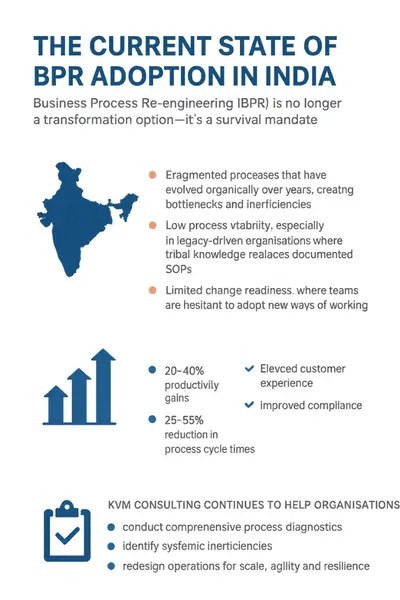
KVM Consulting continues to help organisations conduct comprehensive process diagnostics, identify systemic inefficiencies, and redesign operations for scale, agility, and resilience.
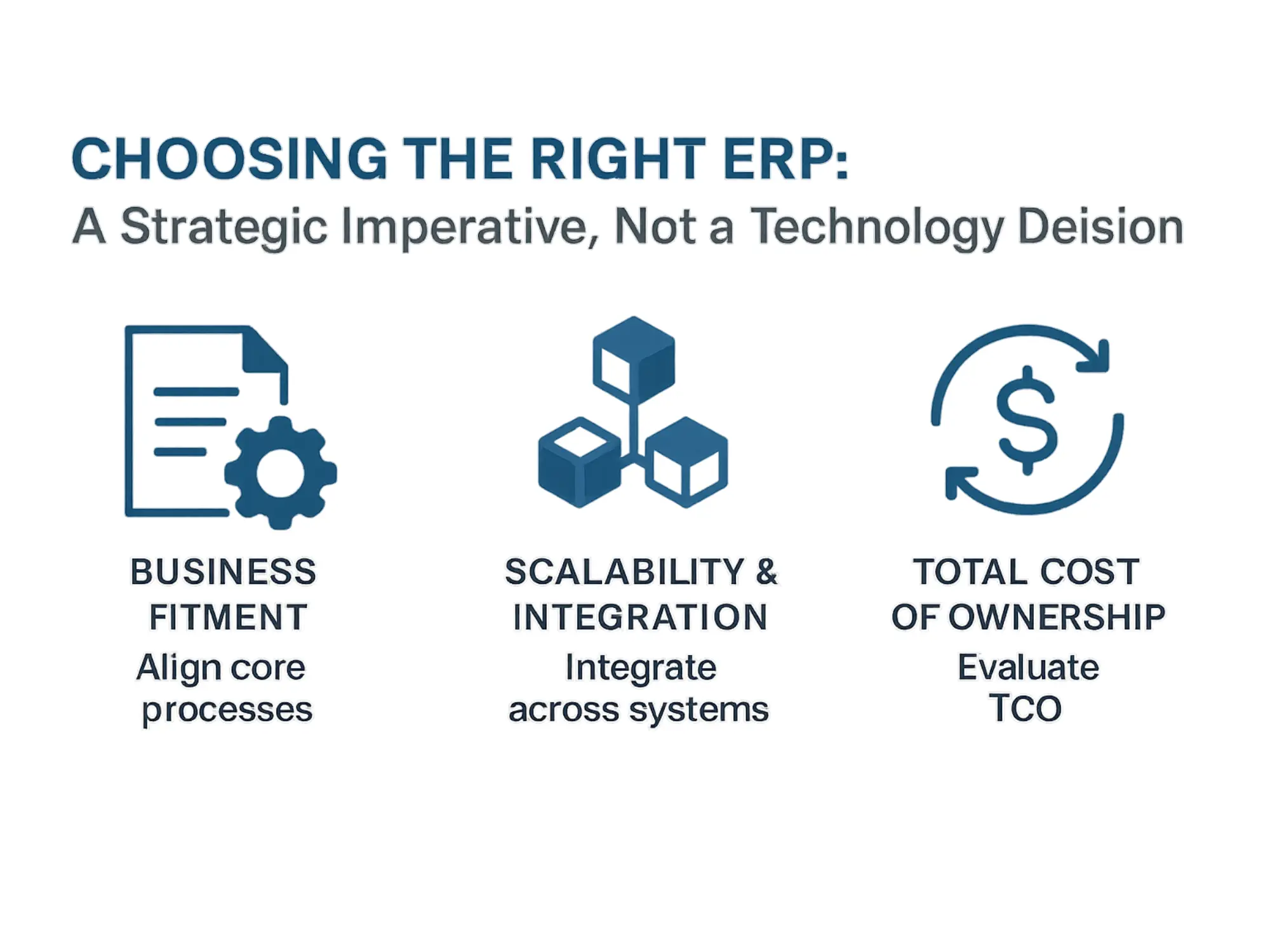
- Choosing the Right ERP: A Strategic Imperative, Not a Technology Decision
Today, ERP adoption is often viewed as an IT upgrade. In reality, it is a business transformation enabler. The Indian ERP landscape is expanding rapidly, with SAP S/4HANA, Oracle Fusion, Microsoft Dynamics 365, and sector-specific solutions gaining traction across enterprises.
To choose the right ERP, organisations must focus on three dimensions:
- Business Fitment
An ERP must align with the organisation’s core processes, industry needs, and long-term operating model. The right selection ensures minimal customisations and higher adoption.
- Scalability & Integration
Modern ERPs must integrate seamlessly with digital ecosystems—IoT systems, automation tools, analytics platforms, and CRM suites. Scalability ensures organisations can evolve without frequent system overhauls.
- Total Cost of Ownership (TCO)
Enterprises must evaluate:
- Subscription/licensing costs
- Implementation & change management
- Support & upgrade cycles
- Infrastructure (Cloud vs On-Prem)
At KVM Consulting, we guide organisations through a detailed ERP readiness assessment, vendor evaluation, fit-gap analysis, and implementation governance to ensure ERP becomes a driver of measurable operational excellence.
- Digital Readiness: Preparing for Clean, Clear & Automated Processes
Digital transformation succeeds only when process clarity meets technology capability. Many organisations invest in automation but fail to realise ROI because the underlying processes are:
- Not standardised
- Not measured
- Not automation-ready
A digitally-ready organisation demonstrates:
- Standardised workflows across all verticals
- Elimination of redundant approvals and non-value-adding steps
- Clear data governance and single source of truth
- Workforce readiness through training and change enablement
- A culture of continuous improvement
Automation—whether RPA, low-code platforms, AI-led workflows, or smart analytics—delivers exponential value only when built on clean and well-designed processes.
- The ROI of a Clean Automation Strategy
Organisations that combine BPR with automation achieve:
- 20–30% cost savings in year one
- Substantial reduction in manual errors
- Faster decision cycles through intelligent dashboards
- Higher workforce productivity and morale
- Improved compliance and audit readiness
At KVM Consulting, our methodology ensures that automation initiatives are tightly linked to value creation, process efficiency, and business outcomes rather than standalone technology deployments.
- How KVM Consulting Can Support You
We provide end-to-end transformation services that include:
- Process Assessment & Diagnostics
- Process Redesign & Target Operating Model (TOM)
- ERP Readiness, Evaluation & Implementation Support
- Digital & Automation Enablement (AI, RPA, Workflow Automation)
- Change Management & Capability Building
- Performance & Continuous Improvement Programs
Our goal is to help organisations operate smarter, faster, and more profitably—backed by transparent processes, strong technology foundations, and aligned teams.